
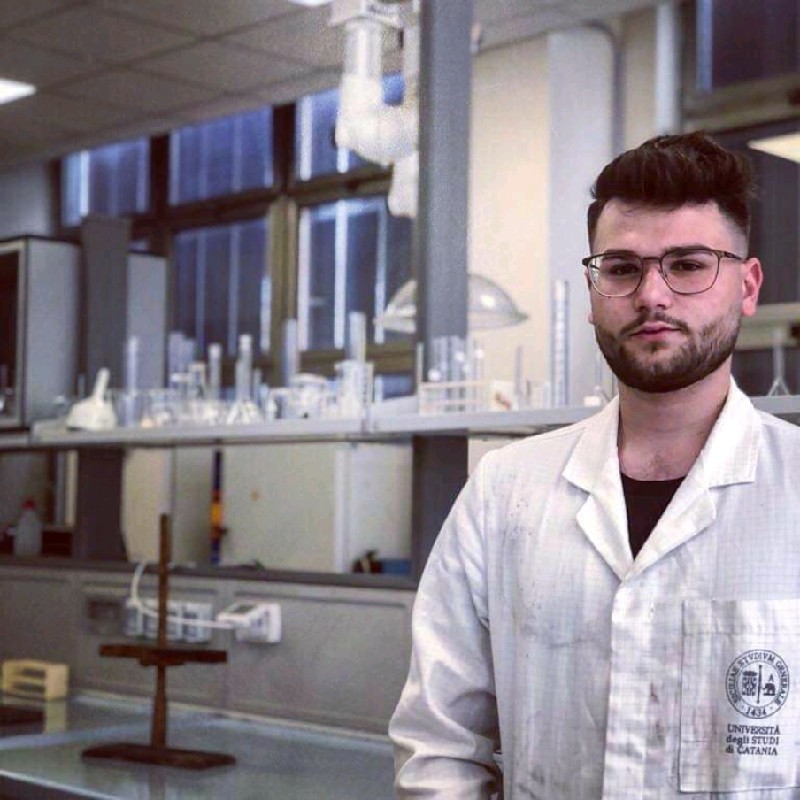
Alessandro Grasso was born in Biancavilla (CT), Italy, in 1998. He earned his Bachelor’s degree in Industrial Chemistry from the University of Catania in 2021 with honours, completing a thesis focused on the synthesis and characterization of polymer-based nanocomposites designed to withstand extreme conditions simulated beyond low Earth orbit. In 2024, he obtained his Master’s degree in Chemical Sciences, also with honours, defending a thesis on the synthesis and characterization of new organic chromophores for OPV photovoltaic devices under the supervision of Prof. Carmela Bonaccorso.
From November 2024 to October 2025, he worked as a research fellow at the Department of Chemical Sciences, contributing to the design and synthesis of new heterocyclic compounds with potential biological activity under the supervision of Prof. Cosimo Gianluca Fortuna and Prof. Bonaccorso.
He is currently a PhD student in Chemical Science at the University of Catania, supervised by Prof. Cosimo Gianluca Fortuna and Prof. Carmela Bonaccorso. His doctoral project, titled “Design and synthesis of new heterocyclic p-Azaquinodimethane chromophores as versatile push–pull systems for singlet fission in organic electronics”, builds upon and expands the work carried out during his Master’s thesis, with a particular focus on multiexcitonic processes and advanced organic optoelectronic materials.
Thesis title: Design and synthesis of new heterocyclic p-Azaquinodimethane chromophores as versatile singlet fission push-pull systems for applications in organic electronics.
Thesis abstract: This project aims to develop new p-AQM chromophores as efficient singlet-fission materials for next-generation photovoltaics. Computational design, modular synthesis, and advanced ultrafast spectroscopies will optimize excited-state energetics, triplet yield, and charge transfer. The best systems will be integrated into c-Si and perovskite devices to demonstrate efficiency gains beyond conventional limits.
Keywords: en: organic chromophores, organic electronics, singlet fission, p-AQM, heterocyclic compounds
